MCL’s Hyperspectral Imaging Capability Enhances Defence ISR Operations
16 June 2025
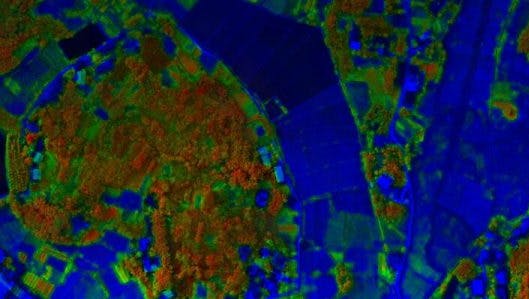
MCL have advanced its intelligence, surveillance and reconnaissance (ISR) portfolio with the integration of hyperspectral imaging technology, a capability that provides enhanced detection of concealed threats in operational environments.
Army Technology recently covered our hyperspectral imaging development, detailing how this technology combines spectroscopy with digital imaging to identify hidden assets that evade conventional detection methods.
Technical Advancement in Real-Time Processing
The breakthrough in operational viability stems from advances in processing capabilities. As our Projects Director James King explained to Army Technology, the critical factor is data delivery speed. Historical limitations in processing large hyperspectral datasets restricted military applications until recent technological developments enabled real-time analysis.
“The most critical thing is how fast you are able to provide the data, even the analysed data, the information you’re interested in,” King noted. “This was not possible 15 years ago… until now, hyperspectral imaging data was large and bulky.”
Strategic Partnerships and Development
Our five-year development programme has involved close collaboration with HySpex (Norway) and Cubert (Germany), specialised manufacturers of hyperspectral imaging systems. This partnership approach has enabled us to integrate proven sensor technology with tactical deployment platforms, particularly uncrewed aerial systems (UAS).
The technology itself works by analysing how matter interacts with electromagnetic radiation across multiple spectral bands. This provides operators with the ability to detect anomalous features in real-time images, even when targets are deliberately concealed or camouflaged within complex environments such as dense foliage or thermal camouflage garments.
Operational Deployment and Applications
The system offers flexible deployment options across multiple platforms, from satellite integration to ground-based arrays. When deployed on UAS at 100-metre altitude, the system provides approximately 30 metres of ground coverage, suitable for tactical reconnaissance and threat detection in challenging terrain.
MCL demonstrated the capability during a media preview on 11 June 2025, ahead of the DSEI exhibition scheduled for September at London’s ExCeL Centre. The system has undergone successful trials in Europe throughout 2025, validating its effectiveness in operational scenarios where concealment in vegetation presents significant detection challenges.
Complementary ISR Capability
Hyperspectral imaging functions as a complementary tool within broader ISR frameworks, working alongside thermal imaging and other surveillance technologies to provide comprehensive situational awareness. This multi-layered approach enhances detection confidence and reduces false positives in complex operational environments.
As the global military UAS market continues to expand—projected to grow from $13.6 billion in 2025 at a compound annual growth rate of 6.3%—the integration of advanced payloads like hyperspectral imaging represents a significant capability enhancement for defence operators worldwide.
Read more: MCL adds another layer to ISR with ‘hyperspectral imaging’ – Army Technology